World news
What Emmanuel Emefienim’s story teaches us about Nigeria’s possibilities

By Ehi Braimah
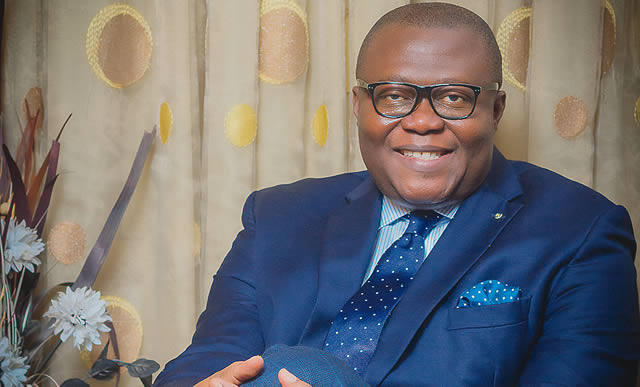
I joined The Platform live on Channels Television on Thursday October 1 to listen to inspiring conversations about Nigeria. What I heard from Dr. Emmanuel Emefienim, Founder and Managing Director/CEO of Premium Trust Bank, was much more than a motivational speech. It was a masterclass in resilience, ambition, leadership, relationships, knowledge, faith and the power of refusing to give up.
The Platform, organised by The Covenant Place under the leadership of Senior Paster Poju Oyemade, has become an important public conversation that brings Nigerians together around ideas, experiences and possibilities. Held on May 1 and October 1 in a town-hall setting and televised live, it has consistently provided a platform for Nigerians to share stories that can inspire particularly the younger generation to believe in themselves and in their country.
Dr. Emefienim’s story deserves to be told beyond the walls of The Platform because it is not simply the story of one successful banker; it is a Nigerian story about what can happen when adversity meets determination. After completing his NYSC, Emefienim applied for 70 jobs. Only four organisations, according to him, responded. He eventually joined Oceanic Bank at the age of 22.
At some point, he was transferred from Lagos to Asaba. His career subsequently took him to Savannah Bank in Port Harcourt, where he became a regional manager. Then came the shock that could have destroyed everything. I mean, everything: his plans, big dreams and bright future.
One weekend, Emefienim travelled to Warri to spend time with his family. When he returned to work on Monday, he discovered that Savannah Bank had been liquidated. There were no members of staff waiting for him. Instead, officials of the Central Bank of Nigeria and the Nigeria Deposit Insurance Corporation were there. There had been no warning.
Suddenly, the man who had an official car and driver was without a job. He was married, in his 30s, and his wife was a civil servant. His professional world had collapsed almost overnight. What did he do? He did not give up.
His driver took him to Benin City. From there, he travelled to Lagos, using a public transport service, to see a manager at FSB, a bank that had previously offered him a job while he was still at Savannah Bank. He had declined the offer then. Now, Emefienim needed the job, but the manager, obviously angry and wanted to have his pound of flesh back, ignored him and kept him waiting for three days.
It would have been easy to interpret the experience as humiliation and walk away. But Emefienim remained focused. Eventually, the manager saw him and offered him a job – but at a lower level. He moved from senior manager to deputy manager and was posted to Yenagoa in Bayelsa State which he accepted as he had no choice at the time.
That decision contains a profound lesson: sometimes, starting again is not failure; it is strategy. There are moments in life when circumstances force us to take a step backwards so that we can eventually move forward. The important thing is not the temporary position we occupy, or feelings of rejection experienced or disappointments that we face, but whether we can continue moving towards the destination.
Emefienim had a big dream. He recalled telling the Managing Director of Oceanic Bank and some colleagues that one day he would become the managing director of a bank himself. While the MD encouraged him to pursue his goal, his colleagues laughed at him.
His response is one of the most memorable lines from his presentation: when people don’t laugh at your dream, perhaps the dream is not big enough. That is a message Nigeria’s young people need to hear.
Too many young people allow their current circumstances to define their future, but the future does not necessarily resemble the present. A young person who is struggling today may become an employer tomorrow, and someone rejected for a job may eventually build an institution that employs hundreds or thousands of people.
Emefienim’s own journey demonstrates this. He continued to rise through Equatorial Trust Bank and later Sterling Bank, following mergers and acquisitions in the Nigerian banking industry. He rose through the ranks – AGM, DGM, GM and Executive Director – while continuing to acquire knowledge.
He attended Harvard Business School several times. But perhaps more importantly, he did not keep the knowledge to himself – he invested in people. He personally sponsored some of his managers to also attend Harvard. When the time came for him to leave Sterling Bank and establish Premium Trust Bank, six of the seven managers he had trained agreed to join him.
That is a powerful definition of leadership. A leader is someone who reaches the top and helps others rise. This is particularly important in Nigeria, where the quality of human capital will ultimately determine how competitive our economy becomes. Buildings, technology, capital and infrastructure matter, but people make institutions work.
Emefienim also spoke about relationships and networks as critical elements of success. This is another lesson worth emphasising. Knowledge is important, but relationships create opportunities for knowledge to be applied. Networks create access, partnerships and possibilities because nobody succeeds entirely alone.
His story also contains an important lesson about family resilience. After experiencing the trauma of losing his job without warning, he empowered his wife to start a business. He wanted to ensure that his family would never again be placed in such a vulnerable position because one person’s employment had suddenly disappeared resulting in loss of income.
That was more than a financial decision – it was an act of foresight. Today, the story has come full circle. The young man who once submitted 70 applications looking for employment is now the founder and owner of a bank.
Premium Trust Bank, which commenced commercial banking operations as a regional bank in April 2022, has grown into a national banking institution with 35 branches. Emefienim spoke proudly about its growth and profitability and its successful participation in the banking industry’s recapitalisation programme, raising N200 billion, the threshold for national banks, and achieving a historic milestone as one of Nigeria’s 10 most profitable banks.
There is something profoundly Nigerian about this story. Nigeria is often described in terms of its problems – unemployment, infrastructure deficits, insecurity, poverty, weak institutions and other challenges. These problems are real and should not be minimised.
But Nigeria is also a country of extraordinary human possibilities. Our greatest resource is not oil neither is it our large population; it is the capacity of Nigerians to create, innovate, adapt, build businesses, solve problems and compete. This is one of the central ideas behind my forthcoming book, How Naija can conquer the world.
The book is about Nigeria’s economic potential, global ambition and the strategies required to achieve greater prosperity. I argue that Nigeria’s success should not be measured simply by the size of its economy. Instead, we should be concerned about rising incomes, productivity, exports, globally competitive companies, human capital and the ability to create value for the world.
Emefienim’s story illustrates several of these principles. He acquired knowledge, built relationships, invested in people, remained focused, executed consistently, understood his environment, adapted when circumstances changed, dreamed beyond his immediate reality, and remained anchored in faith.
His reference to what he calls “revelational knowledge” – spiritual insight and instruction he believes come from God – adds another dimension to his philosophy. For him, formal education and professional experience are important, but they exist alongside faith and spiritual guidance.
There is another lesson here for Nigeria: we need more people who are prepared to build institutions rather than merely look for opportunities. When Nigerians build strong companies, they create jobs, and when they invest in people, they create human capital. We have the capacity to develop globally competitive products and services for exports. Clearly, the moral of Emefienim’s story is that we should build institutions that survive beyond their founders and contribute to national prosperity.
This is how a nation moves from potential to prosperity.
Listening to Dr. Emefienim, I was reminded that Nigeria does not lack stories of courage, enterprise and achievement. Perhaps what we lack is a sufficiently organised effort to tell these stories and convert them into a powerful national narrative.
We need to tell young Nigerians that setbacks are not destinies. An entrepreneur’s small business today can become tomorrow’s major institution. We need to tell professionals that continuous learning matters; tell leaders that investing in people is one of the highest forms of leadership, and also tell the world that Nigeria is much more than the challenges that frequently dominate international headlines. Dr. Emmanuel Emefienim has done well.
From a young graduate searching for his first job, to a banker who survived the collapse of a major institution, got another job within four days, to a senior executive, and an entrepreneur who built his own bank, his journey is a powerful reminder of what determination can accomplish.
His story is not an invitation to ignore Nigeria’s problems, but he is simply saying we should confront them with courage. Nigeria needs more dreamers – but also more doers. We need people who can dream big, acquire knowledge, build relationships, invest in others and execute with consistency.
That is how nations are built.
Perhaps that is the deeper message of The Platform: Nigeria’s future will be created by Nigerians who believe that something better is possible – and then roll up their sleeves and build it.
Braimah is a PR specialist, marketing strategist, and publisher/editor-in-chief of Naija Times (www.ntm.ng) and Lagos Post (www.lagospost.ng). He is a strong advocate for African prosperity and can be reached through: [email protected]





White House Press Secretary Katie Zacharia was pushed out Friday after less than a week in the high-profile job, following a series of blunders that added to distractions for her embattled boss President Donald Trump.
“Can confirm,” a White House official told AFP, after Fox News reported that Zacharia, 41, was “transitioning out.”
The writing was on the wall earlier when Trump made clear he was ready to see his newly minted spokeswoman go amid criticism that she had pretended to be a lawyer and over her one, much-mocked press briefing.
“I said, ‘Katie, is this for you?,’” Trump told reporters. “I said, ‘Katie, you don’t have to do this’… I said to her, ‘Honestly if I were you I’d reconsider.’”
Zacharia only began her job five days ago, taking over from the combative Karoline Leavitt, who helped Trump reshape White House coverage by bringing in more friendly outlets and fiercely attacking critical media.
Zacharia had got off to a rocky start with her debut press room briefing Tuesday morning.
It lasted less than 15 minutes, beginning with a remarkably slow reading out of what she said were Trump’s many accomplishments — then taking just three questions from journalists.
The kerfuffle is a distraction for 80-year-old Trump as he flies around the country trying to boost Republican candidates ahead of the November 3 congressional midterm elections, with polls predicting a drubbing.
The Republican leader himself also faces ever-lower polls as Americans sour over the war against Iran, inflation and perceptions of corruption.
Zacharia had described herself as a lawyer during television appearances and on social media, and listed herself as general counsel of a California-based conservative nonprofit.
While she does have a law degree from a California university, she acknowledged Thursday she had failed the bar exam, a prerequisite for practicing law in the United States.
She embarked on a series of damage-control interviews on Trump-friendly outlets, but they did no good.
In one of them, Fox News’ Sean Hannity, a close Trump ally, appeared dismissive of Zacharia.
He asked the press secretary if she ever retook the bar exam. She replied: “I did not.”
“It was never my intent to go into the practice of law,” she said.
In another interview Thursday with pro-Trump outlet Real America’s Voice, Zacharia said she had registered to take the bar exam but was “distracted and overwhelmed” by plans to move to China with her husband.
Zacharia said “many people in the field” had assured her that she could “label myself a lawyer,” given her law degree.
“Fox and Friends,” which often conducts friendly interviews with Trump administration officials, was unusually direct Friday when a host asked Zacharia if she still had the confidence of the president.
“I hope to be able to build the trust and confidence of everyone around me,” she said, sidestepping the question.
Zacharia further stirred controversy on Thursday when she disparaged China, whose leader Xi Jinping was recently Trump’s guest in a pomp-filled Washington visit.
The press secretary recalled the perception in 2016 was that China would soon overtake the United States.
“I remember this very distinctly, having just come from China, thinking, ‘How is China the next country on the horizon? They don’t even have proper toilets,’” she told right-wing influencer Jack Posobiec in an interview.
Chinese Foreign Ministry spokeswoman Mao Ning responded Friday that Zacharia should “visit China more often.”
AFP

US President Donald Trump said Wednesday that he wants to see Pope Leo XIV “get well” after the pontiff underwent surgery in Rome this week to remove a cancerous tumor.
“I want to see Pope Leo get well,” Trump told reporters after addressing a campaign rally in Arizona. “It’s big stuff. Anytime you have cancer, but the prognosis seems to be good.”
“I just want to wish him well. Get better fast,” the president added.
Pope Leo’s doctors said Wednesday that he was out of bed, walking and eating after the removal of a cancerous tumor from his lung.
Now the 71-year-old awaits the results of a biopsy to determine if the cancer has spread.
Prayers for the recovery of the Catholic leader of 1.4 billion faithful have been sent from around the world, from the northern Peru city of Chiclayo where he was bishop for eight years, to his US hometown of Chicago and beyond.
Other global leaders also offered best wishes, including Britain’s King Charles III, who is being treated for an undisclosed cancer and last year became his country’s first monarch to pray publicly with the pontiff since the Church of England broke with the Vatican 500 years ago.
Earlier this year, the pope said he has “great love” for the United States, but his stances urging tolerance and protection for migrants have often put the Vatican at odds with the Trump administration’s crackdown on immigration and use of detention camps.
On Wednesday, Trump also noted that he had spoken to the first American pope’s brother, Louis Prevost, in the past.
“His brother’s a friend of mine who’s a great, he’s a fantastic guy, and his wife. You know, they’re big Trump supporters,” Trump said, adding “his brother loves him a lot, loves the Pope a lot, and that’s good. That’s good enough for me.”

Pope Leo XIV will be admitted to hospital on Tuesday morning for an operation to remove a lump from his lung, the Vatican said.
The 71-year-old Leo announced on Sunday that he would undergo an operation “in the coming days”.
The surgery to remove a pulmonary nodule, a small growth of tissue in the lung, will mark the pope’s first hospitalisation since he became head of the 1.4 billion Catholics on May 8, 2025.
Vatican spokesman Matteo Bruni told AFP on Monday that the pontiff would be admitted on “Tuesday, late morning”.
The recovery time could be about a week, the Vatican said.
The operation is expected to take place at Rome’s Gemelli hospital, which has a dedicated papal suite.
In a surprise announcement following Angelus prayers on Sunday, Leo told assembled crowds in St Peter’s Square that doctors had discovered the nodule “at a very early stage” during recent medical checks.
“The doctors believe it would be right to intervene and so, following their advice, I have decided to have the operation to remove it,” he said.
A pulmonary nodule is a small growth in the lung. Most are benign, meaning they are non-cancerous. But a small percentage can be an early stage of lung cancer.
Most small nodules cause no symptoms and are only discovered during checks for other health issues.
Larger nodules can cause shortness of breath, chest pain and persistent coughing — sometimes with blood.
The operation is normally carried out under general anaesthetic with the patient breathing through a tube.
Rome’s Gemelli hospital, north of the Vatican, is where popes are usually treated.

&m
-

 Entertainment5 years ago
BBNaija: “Shameful For A Married Woman” – Boma, Tega Doing ‘Stuff’ Under Duvet Sparks Outrage (See Video)
-

 Entertainment5 years ago
Singer, Oxlade In Big Mess After His Sex Tape With A Strange Lady Surfaces Online (Watch Video)
-
 Entertainment6 years ago
BBNaija: Kiddwaya Sucks Erica’s Boobs, Licks Dorathy’s Neck In Truth Or Dare Game (Video)
-

 Entertainment3 years ago
I’m Not Ashamed Of My Leaked Nude Photos, Ifunanya Confesses (See Photos)
-
 Crime1 year ago
NDLEA intercepts Saudi, UK-bound cocaine in lipsticks
-
 Entertainment6 years ago
I’m Not Sick But Only Lost Some Weight – Kiss Daniel
-

 Crime1 year ago
NDLEA seizes N3.4bn worth of opioids in Lagos, PH, uncovers drugs in chocolate tins
-

 Politics5 years ago
AMCON Takes Over Former Governor’s Mansion Over ₦5bn Debt